
Apollo, whose origins can be traced back to a mixed Hittite and Indo-European heritage, has come to be expressed as the god of many elements. In this context, since his name means ‘light’, he is seen as both the God of Light and the God of Harmony, as it evokes the sun, balanced and harmonious control, order, knowledge and wisdom. He is also referred to as the God of music, poetry, and fine arts in the sense that he is considered an ideal youth figure, and the God of Archery due to his superior archery skills.
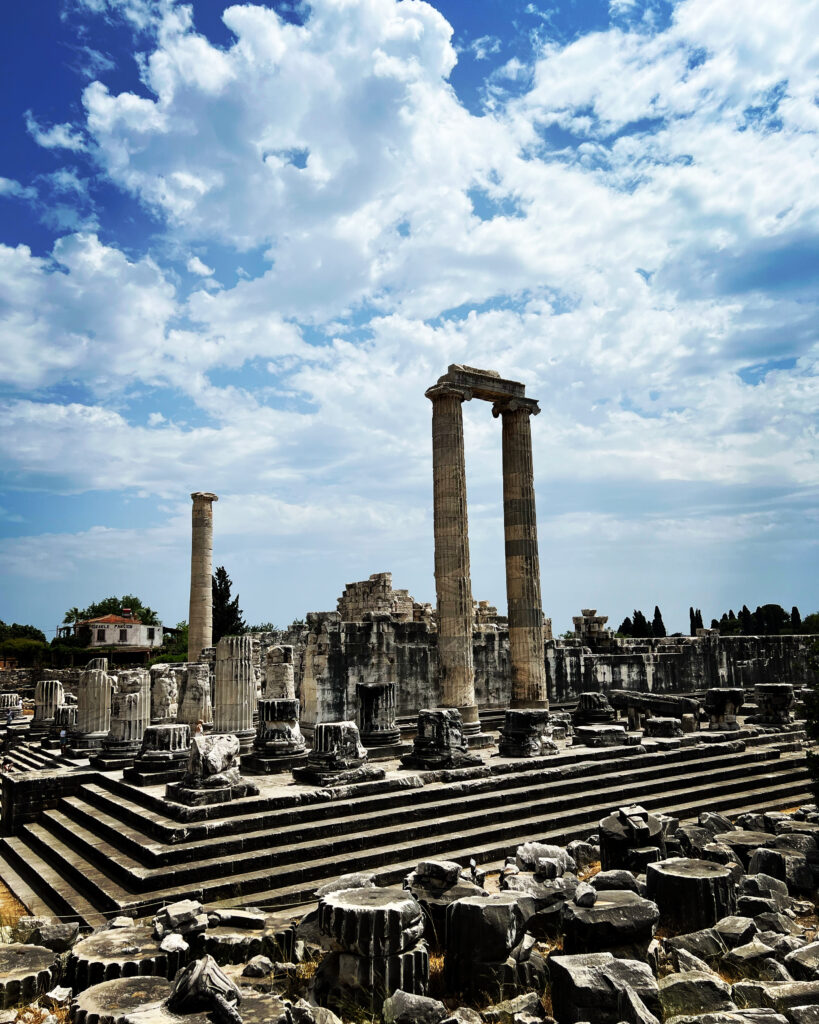
Furthermore, the God Apollo is also known as the god of medicine and healing, bearing the supplementary name ‘paian’, meaning ‘healer’, ‘cure-all’, and yet he is also believed to have the power to cause epidemics and diseases. In fact, all the physicians mentioned throughout the Homeric epics are the sons and students of this Paian god. Therefore, it is not a coincidence that Asclepius, who is known mainly as the God of Healing or Medicine, in a sense surpassing his father, was born from the god Apollo after a somewhat complicated adventure.
Apollo, one of the 12 gods on Mount Olympus, had many homes, but most mythologists agree that he loved Delos and Delphi (Delphi) the most. Delos is a desolate island in the middle of the Aegean Sea, swept by a rocky sea. Apollo was both born and raised there by his mother Leto, who fed him with nectars.
The Temple of Delphi:
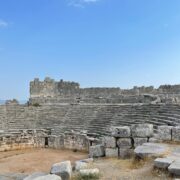
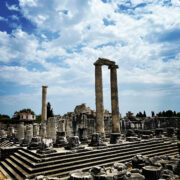
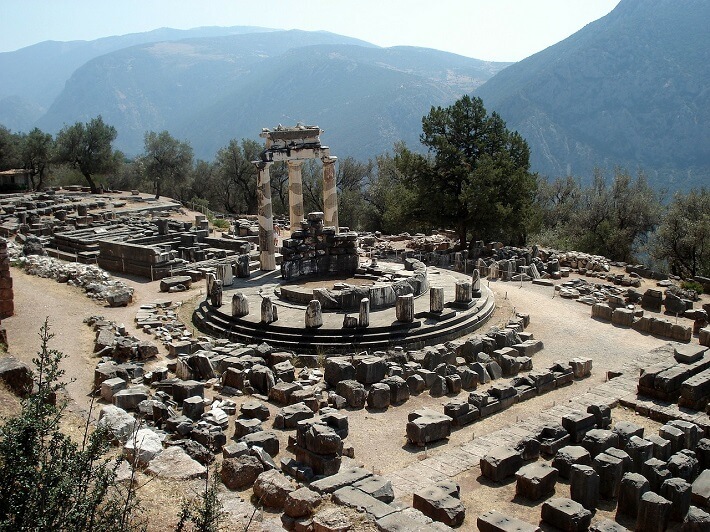
When he was four days old, the god Apollo ventured to Delphi on the Greek mainland, where he killed the dreaded serpent Python. He then took over an Oracle center on the island and had the Temple of Pytho built on the spot where he killed the serpent dragon Python, which later became known as the Temple of Delphi.
As in all representations of Apollo, he has a very young appearance, wearing no clothes except the cloak covering his shoulders. He stands against a tree trunk. A snake is wrapped around the tree trunk and Apollo is holding out his left arm as if he is about to punish it.
Celebrated in honor of Apollo’s victory over Python, the Pythian Games (the main event that later evolved into the Olympic Games) were held every four years in Delphi. In the first celebration of these games, gods, goddesses, and heroes competed for the prize of a crown, at first made of gold or silver, but later of laurel leaves.- The entire island of Delos, which was worshipped with great solemnity since it was his birthplace, was also sacred to Apollo. Therefore, great care was taken to preserve its sanctity, which is why no one was buried there.
In Apollo’s honor, wolves and hawks were sacrificed; for him, sacred birds were the hawk, the raven, and the swan.
The temple became renowned as the Oracle Center of Apollo; it is even said that the god Apollo stole it from Grandmother Earth because of its spectacular location, overlooking the rocky landscape of Delphi. And between these cliffs, rising even higher than the mountains, there is a deep crevice, which Greeks believed to be the very center of the world, its navel [navel stone = omphalos]. For it is said that two eagles sent by God Zeus, the father of God Apollo, one from the east and the other from the west, arrived there at the same time.
In the Temple of Delphi, an oracle center that had famous mottos such as ‘know thyself’, Apollo began to predict the future through a priestess called Pythia (the Pythia of Delphi). In a sense, Pythia, who served as the ‘knowing woman’ of the god Apollo, would sit on a three-legged chair on the rock where the crack was located. Whenever she heard a question being asked, she would go into a strange trance before answering. Some said this trance was caused by smoke rising from the rocks, while others said it was caused by her chewing laurel leaves (believed to be Apollo’s tree) and drinking the water of the sacred spring.
Thus, Pythia, who would become entranced and mutter intricate words, would give answers to Apollo’s questions often in the form of riddles, but always with Apollo’s wisdom in them. Hence, the words conveyed to the person to whom they were addressed were indeed Apollo’s answers. That is why Apollo was also regarded as the god of prophecy; people would come to this temple to hear about their future, purge away their sins or get good advice.
For this very reason he is also known as the god of Orphic religion, in which an entire system of thought, promising security and eternal life to its initiates, was associated with the name of the god Apollo. Additionally, he was even believed to be the father of the great mathematician Pythagoras, to whose doctrines similar to his own were often referred. So much so that Pythagoras, who was also the founder of a religious movement in the 4th century BC, was considered by some to be ‘Apollo incarnate’.
References:
Kathryn and Ross Petras; Mythology Tales & Legends of the Gods; Fandex Family Field Guides; Workman Publishing; Mexico; 1998: 9,15.
Pierre Grimal; The Concise Dictionary of Classical Mythology; Editor: Stephen Kershaw; Translator: A.R. Maxwell-Hyslop; Basil Blackwell; Great Britain; 1990: 49-51, 62-63.
Şefik Can; Klasik Yunan Mitolojisi; 6th Edition; Inkılap Publishing House; Istanbul; 1970: 59-60.
Mythology; Editor: Mustafa Alp Dağıstanlı; Translator: Nurettin Elhüseyni; Series of Reference Books; NTV Publications; China; 2009: 84, 132, 177.
Azra Erhat; Mitoloji Sozlugu; 26th Edition; Remzi Kitabevi; Istanbul; 2007: 62-63, 69, 86.
Colette Estin and Helene Laporte; Greek and Roman Mythology; 13th Edition; Trans: Musa Eran; TÜBİTAK Publications; Istanbul; 2013: 33, 104, 142.