
Temple of Apollo / Didyma…
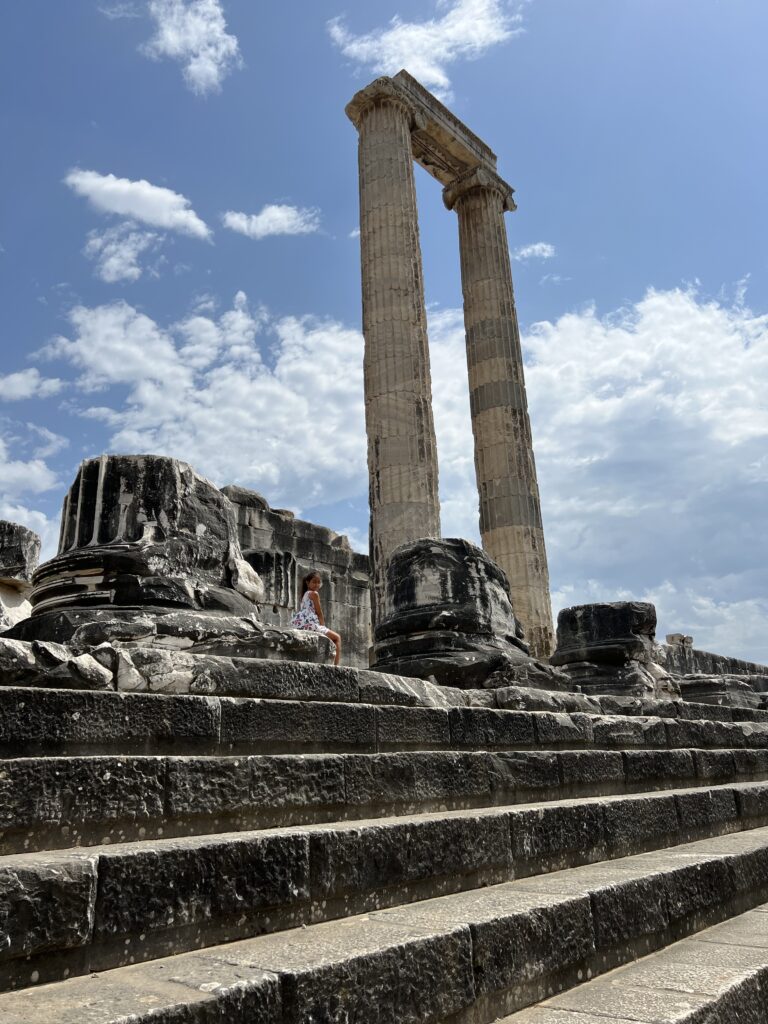
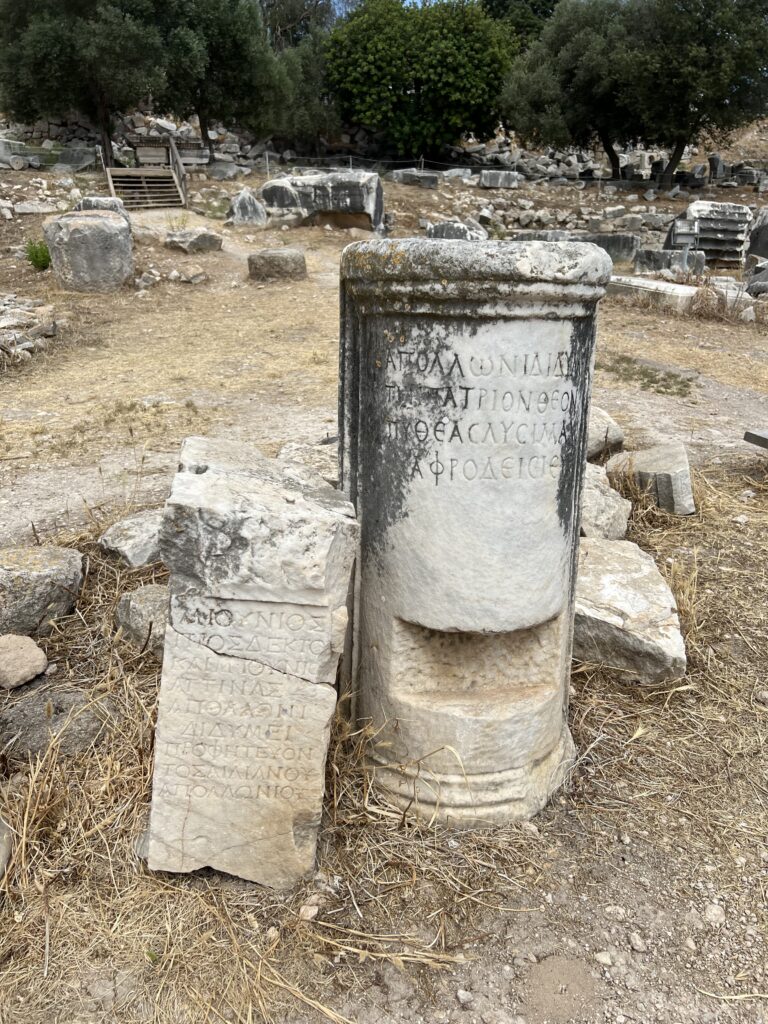
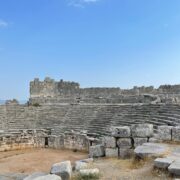
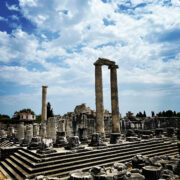
“Didyma Temple of Apollo”, one of the most important oracle centers of the ancient world is located in the city center of Didim district of Aydın Province.
Also serving as the oracle center of important cities such as Ephesus and Priene, which constituted the Ionian (Ion) city-states, the Temple of Apollo was essentially the sanctuary of the ancient city of Miletus, to which it originally belonged. That is why Didyma is not actually an ancient city, but a sacred site. In fact, the temple was destroyed by the Persian army attacking Miletus in 494 BC. Its reconstruction began when Alexander the Great liberated the region from Persian rule. The magnificent temple, whose construction lasted until the middle of the 2nd century AD, was not completely finished. Evidently, a structure of this magnitude could not have been completed easily. For this reason, construction continued in the 3rd and 2nd centuries BC, and some of it even continued during the Roman period. Despite all this, the temple has never been built exactly according to its original plans.
The first written source about Didyma is Herodotus. As Herodotus mentioned and stated above, when Alexander the Great took over Miletus, he gave the management of the temple to the city of Miletus. Due to this act, he was declared the son of Zeus by the local people. With the help of Alexander, the temple took its current form.
According to legend, one day the god Apollo met Brankhos, a shepherd who worked in the Didyma region. Apollo was very fond of his pure soul and kind approach, and he taught him the secrets of prophecy. The shepherd Brankhos, who aimed to share the divine secrets he learned with people, founded the first temple in the name of the god Apollo, near the laurel forest and the water source in the current location of the Apollo Temple.
The Apollo Temple, one of the paradises of the Aegean according to archaeologists, was intended to be built as a counterpart of the Artemis Temple in Ephesus, which was built in the name of Apollo’s sister. They were twins, and their temples should have been identical. If the ancient architects had been able to achieve their goals, perhaps the World’s 8 Wonders, including the Apollo Temple in Didyma, would have been mentioned today…
Historians and geologists agree that the greatest destruction in the Apollo Temple was caused by a major earthquake that affected the entire Aegean region in 1493. The temple, which suffered great damage in this earthquake that occurred 40 years after the conquest of Istanbul by Fatih Sultan Mehmet, was abandoned in the following centuries and became almost a ruin. However, the small settlement established by the local people who took over the fertile land around the temple laid the foundations of Yoran Village, which would gradually become a Greek village in the next hundred years.
According to the historian Herodotus, in the 7th century BC, the Egyptian king Necho and the Lydian king Croesus presented very valuable gifts to Didyma, where a holy temple was located. Herodotus writes in his works that King Croesus sent gifts of gold equal in weight and value to those sent to the Delphi to the Didyma Temple.
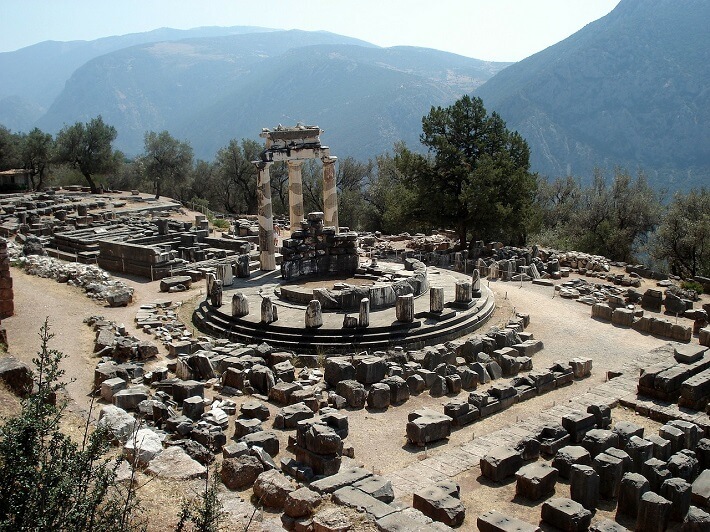
It should be noted that when the god Apollo was only four days old, he went to Delphi on the Greek mainland and killed the fearsome snake Python. Then, on the island, he took over a divination center that foretold the future and established the Pytho Temple at the spot where he killed the serpent dragon, which later became known mostly as the Delphi Temple.
The temple, which became famous as the oracle center of Apollo, was located in such a magnificent place with a rocky Delphi view that it is even said that Apollo stole it from Grandmother Earth. Among these rocks, which reach even higher than the mountains, there is a deep crack, and the Greeks believed that it was exactly the center, the navel of the world. This is because it is said that two eagles sent by Apollo’s father, the god Zeus, from the east and west arrived there at the same time.
At the Delphi Temple, which has famous maxims such as “Know thyself,” Apollo began to predict the future through a priestess named Pythia (Delphoi Pythia). In a sense, Pythia, who served as the “wise woman” of the god Apollo, would sit on a three-legged stool on the rock with the crack. When she heard a question, she would wait in a strange trance before answering. Some said that the smoke rising from the rocks caused this trance. Others believed that the priestess’s chewing of laurel leaves (which was believed to be Apollo’s tree) and drinking from the sacred spring caused it.
In this way, Pythia, who went into a trance and muttered complex words, would generally answer Apollo’s questions in riddles, but there was always Apollo’s wisdom among them. Therefore, the words conveyed to the interested parties were Apollo’s answers. That is why Apollo was also accepted as the god of prophecy; people applied to this temple to learn about the future, to purify themselves from sins, or to receive good advice.
In addition, it is necessary to open a parenthesis for ‘laurel’ here: According to a story, the Delphic Pythia would chew laurel (the tree of Apollo), drink from a sacred spring, and then speak in a trance with complex words, which were actually Apollo’s responses to the inquirer. For this reason, the temple in Didyma is also located among laurel trees. The main important point is that Daphne, who was the first love of Apollo and had a crown of laurel leaves on her head, was the name of the nymph, which means ‘laurel’ in Greek.
As for the temple in Didyma:
In the first half of the 6th century BC, during the most brilliant period of the Ionian world, the Temple of Apollo began to be transformed into a great sanctuary.
■ The center of the Apollo sacred area is a spring related to prophecy located in a depression.
The architectural structure of this archaic temple was influenced by the temples of Ephesus and Samos, which were built roughly around the same period.
If we talk about the architectural structure of the Apollo Temple, which was made as a center for divination:
■ The temple, surrounded by a wide grove of laurel (!),
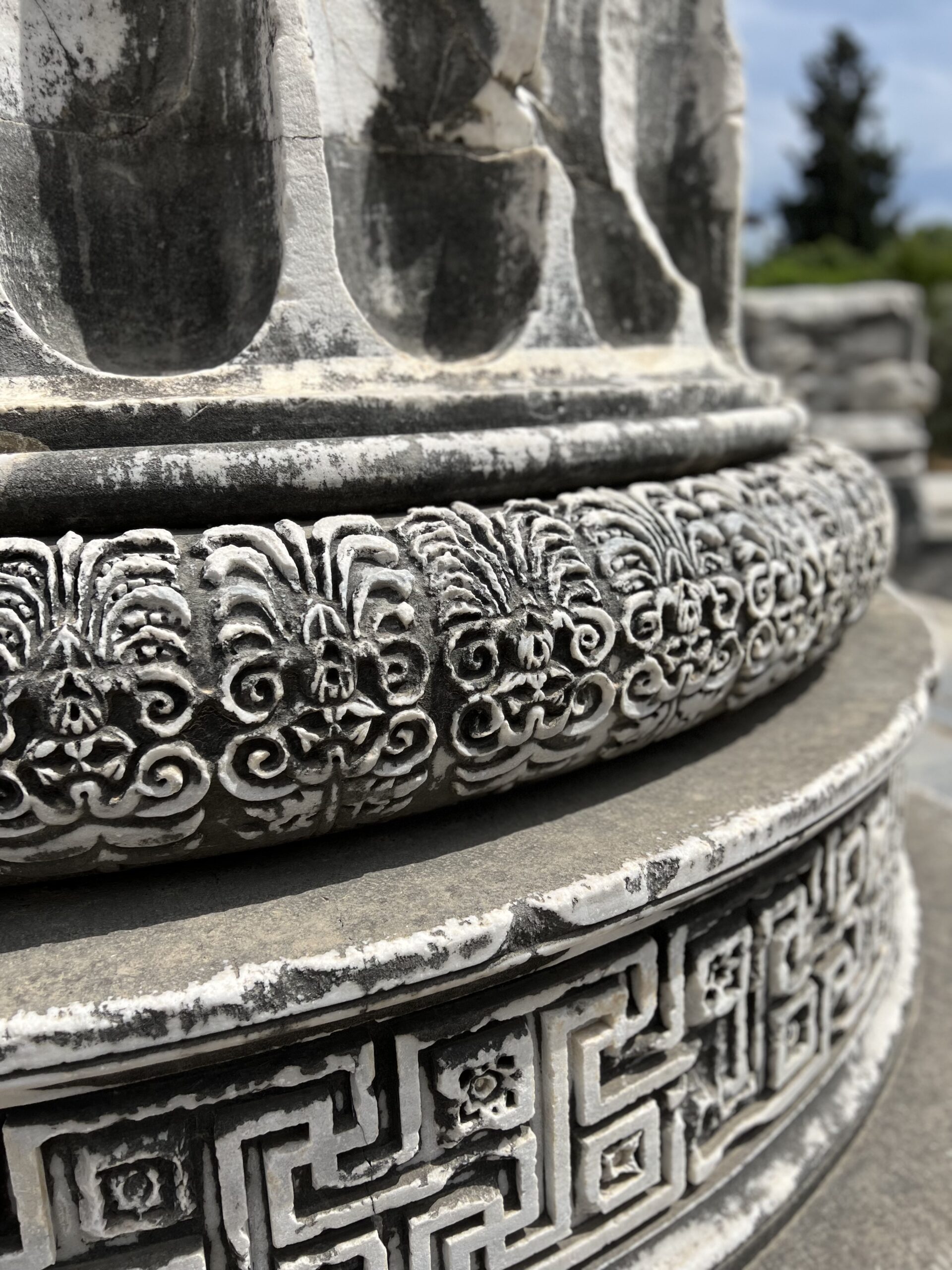
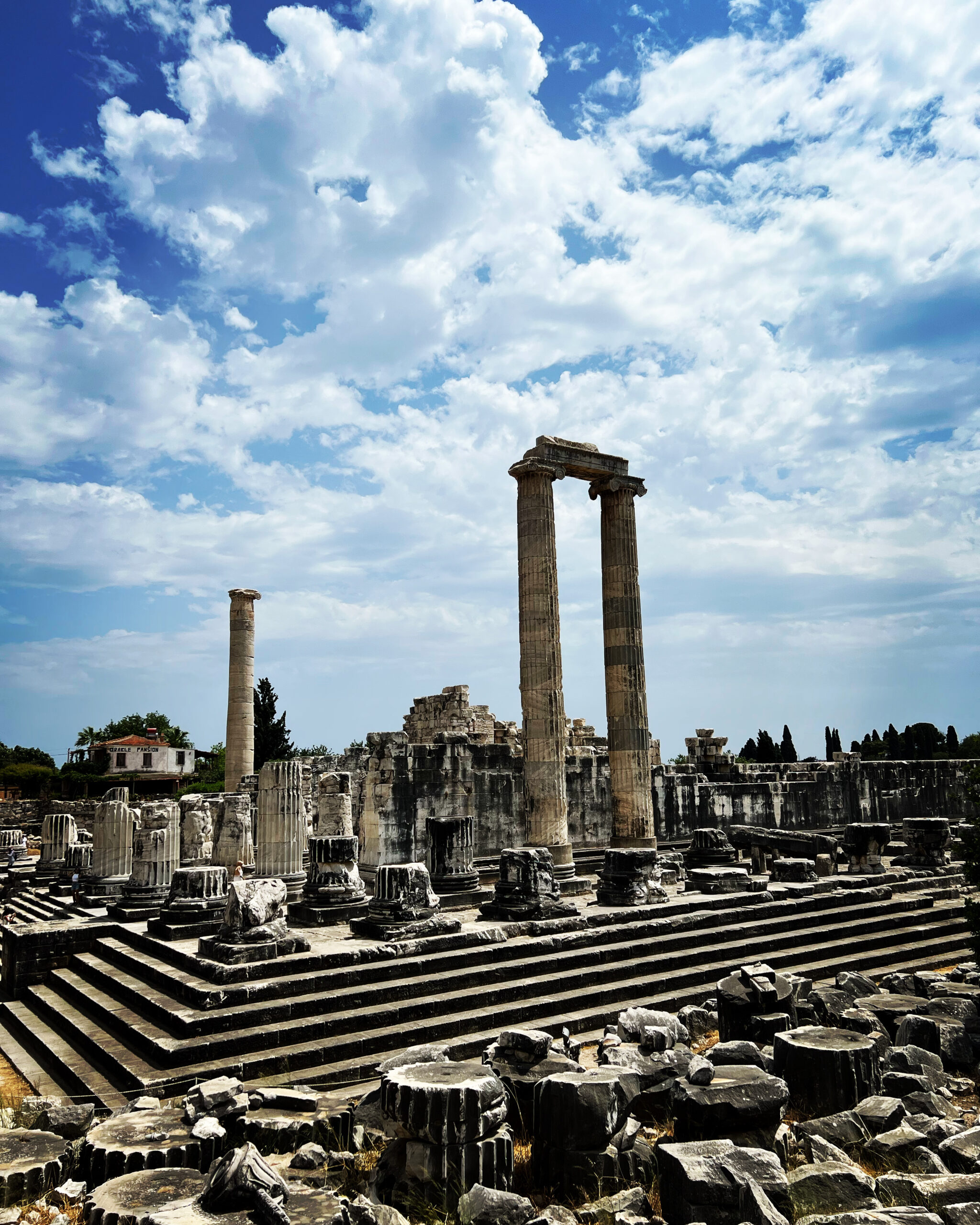
was built on a platform that could be climbed from all four sides by steps, [- built on a seven-step, 3.5-meter-high pedestal and had 14-step entrance stairs in the middle.] It was surrounded by columns arranged in double rows; [- it is dipterous with dimensions of 85.15 x 38.39 meters – meaning it is a temple with a double row of columns around it. It was designed with 21 double rows of columns on the sides, 8 in the front and 9 in the back.]
It has a total of 112 columns, including 104 columns surrounding the inner courtyard called ‘naos’ that the public would use for worship and 8 columns in the ‘naos.’
■ Since the sacred courtyard was surrounded by a 17.5-meter-high wall, it gave the impression of being covered from the outside. However, its high cost and ongoing wars in the surrounding area did not allow the temple’s construction to be completed.
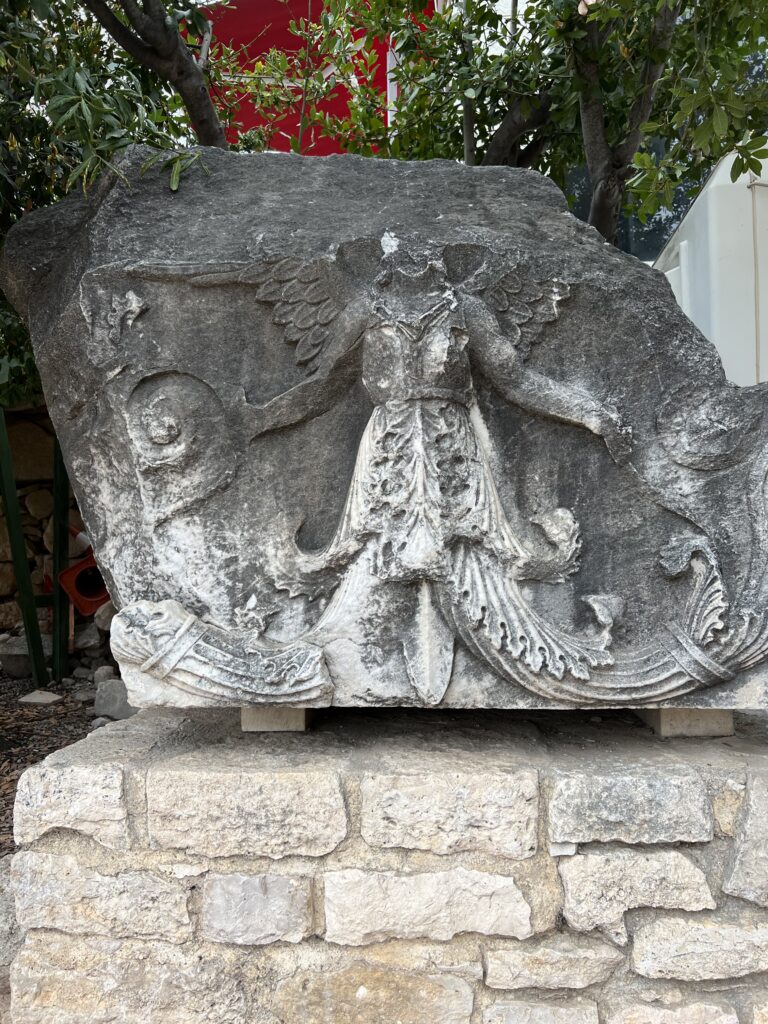
■ The temple’s dimensions (109 x 51 m) were enough to make it the third-largest temple in the ancient world after the Artemis Temple in Ephesus and the Heraion Temple on the island of Samos. In addition, it was very magnificent in terms of the height of its columns. (Every column, including its base and capital, was 19.60 meters high.) The marble statues that covered the sacred road of the temple until 1857 were removed by the British during the decline of the Ottoman Empire and taken to the British Museum.
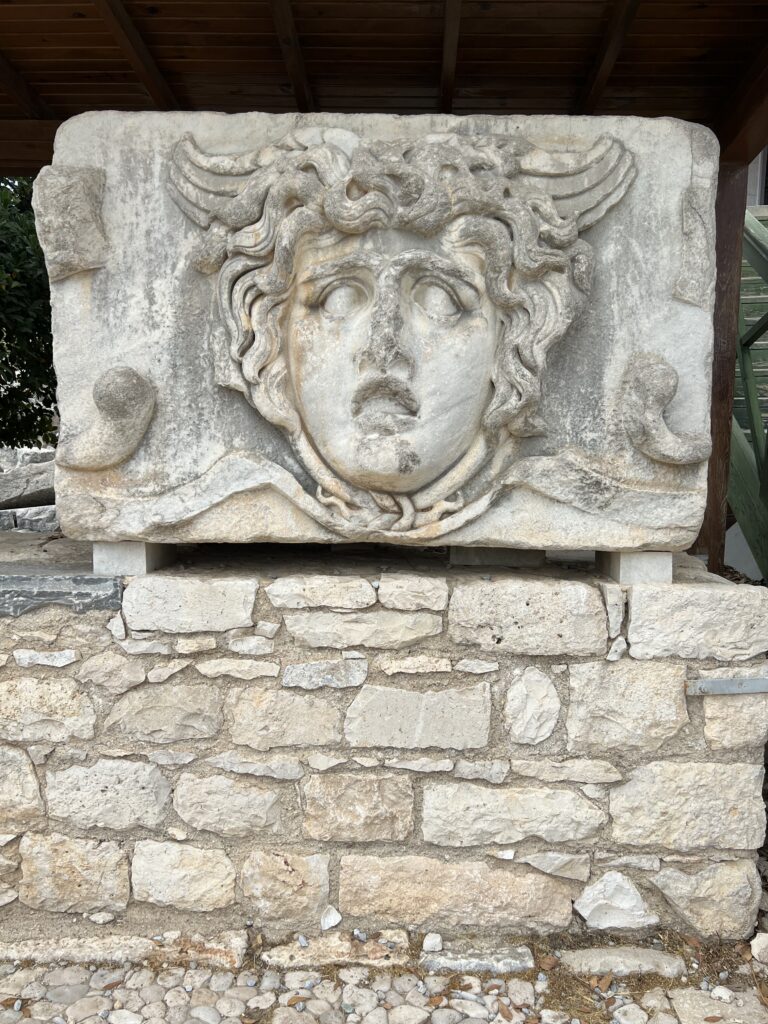
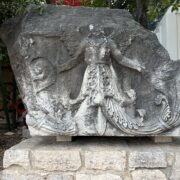
■ The famous Medusa figure, which became one of the symbols of Didyma, is located at the entrance of the temple garden.
References:
Kathryn and Ross Petras; Mythology Tales & Legends of the Gods; Fandex Family Field Guides; Workman Publishing; Mexico; 1998: 9,15.
Pierre Grimal; The Concise Dictionary of Classical Mythology; Editor: Stephen Kershaw; Translator: A.R. Maxwell-Hyslop; Basil Blackwell; Great Britain; 1990: 49-51, 62-63.
Şefik Can; Klasik Yunan Mitolojisi; 6th Edition; İnkılap Yayınevi; İstanbul; 1970: 59-60.
Mythology; Editor: Mustafa Alp Dağıstanlı; Translator: Nurettin Elhüseyni; Başvuru Kitapları Serisi; NTV Yayınları; China; 2009: 84, 132, 177.
Azra Erhat; Mitoloji Sözlüğü; 26th Edition; Remzi Kitabevi; İstanbul; 2007: 62-63, 69, 86.
Colette Estin and Helene Laporte; Yunan ve Roma Mitolojisi; 13th Edition; Translator: Musa Eran; TÜBİTAK Yayınları; İstanbul; 2013: 33, 104, 142.
Yaşar Yılmaz; Ancient Cities of Turkey; 5th Edition; Anadolu Kültürel Girişimcilik; İstanbul; 2022: 85.
Ahmet Uhri; Ephesos (Efes) Gezi Rehberi; Ekin Yayın Grubu; İstanbul; 2010: 20-23, 28-30, 58-61.
https://www.didim.bel.tr/sayfa/4137/apollon-tapinagi
https://turkishmuseums.com/museum/detail/1984-aydin-didim-apollon-tapinagi/1984/1