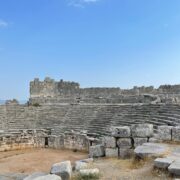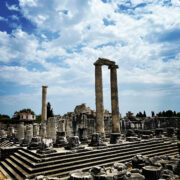

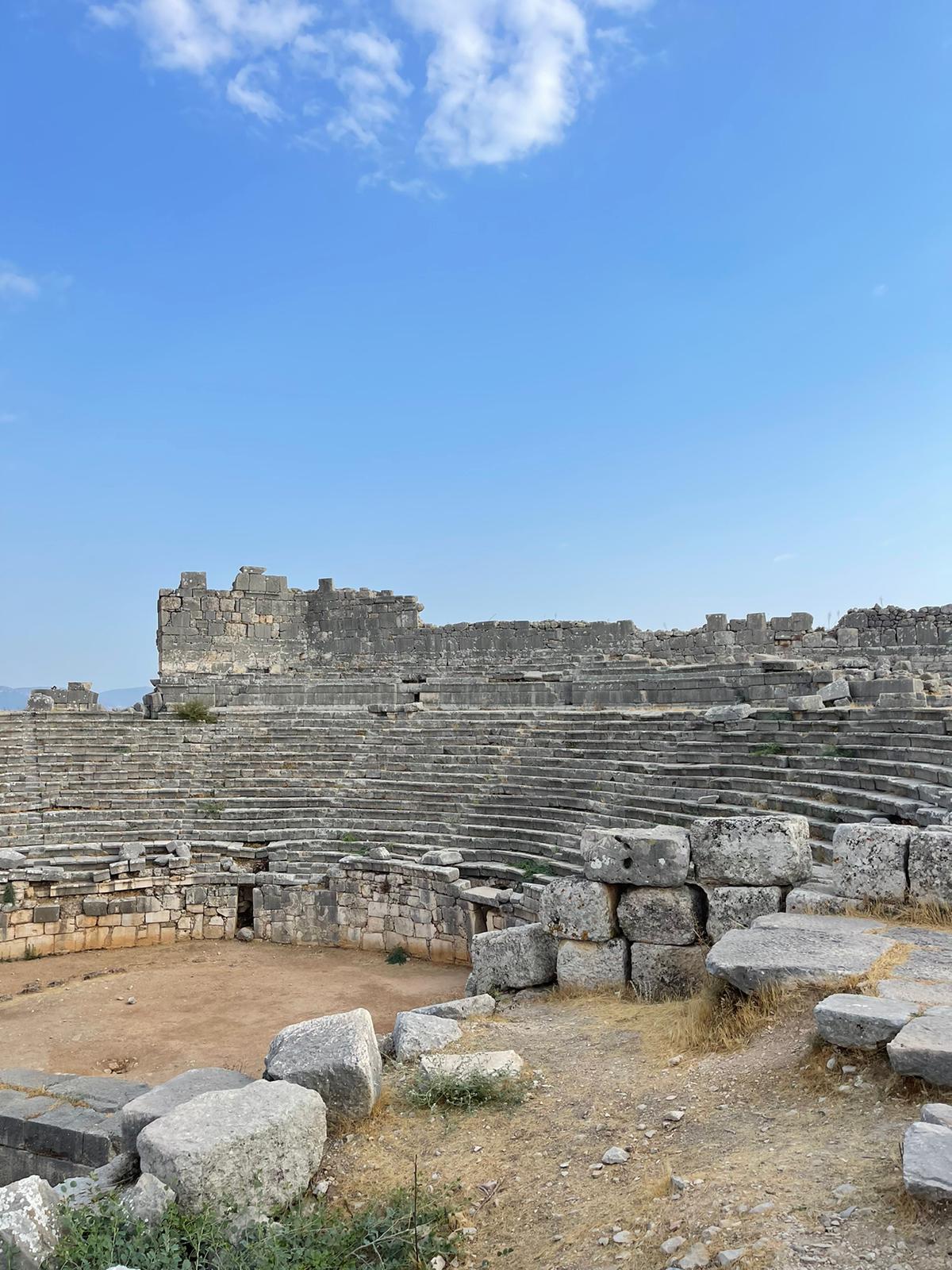
The ancient city of Xanthos, located in Kınık town along the Fethiye-Kaş highway, is considered the largest city of Lycia throughout history. It was both a religious and administrative center. The first information about Xanthos reached us through the Hittites. In the Hittite Yalburt inscriptions, the people of the region were called “Lukkas”, while other Lycian cities at that time were mentioned as Pttar (Patara), Armna (Xanthos), Tlawa (Tlos), Wanawanda (Oenoanda). The name Xanthos first appeared in Homer in the western world on account of the soldiers who went to help in the Trojan wars.
Xanthos was the first Lycian city to be excavated by the British even if not with official permission, but it was also the first Lycian city to be robbed of its reliefs, epitaphs, and sarcophagi. Among the many artifacts that the British transported to London are the Harpy Monument, the Lion Tomb, and the Nereid Monument in the lower Agora, one of the most beautiful works of the classical age, of which we can only see the foundation stones today. These artifacts are exhibited in the British Museum.
In 546-545 BC, when the people of the region realized that they were not going to be able to endure against the attacks of Persian armies led by Harpagos, they committed mass suicide by burning down the city. According to the information given by Herodotus, 80 families who happened to be on the highlands at that time revived the city. A great fire disaster took place here again between 475-450 BC. In 334 BC, Xanthos was captured by Alexander the Great, albeit with some difficulty. According to Appian’s narratives, there are rumors of another suicide attempt involved in this capture. Upon Alexander’s death, Xanthos was taken by Ptolemy, one of Alexander’s generals, in 309 BC, and later by Antiochus III, king of Syria, in 197 BC, only to be left to Rhodes after the defeat at Magnesia. The same year, towards the middle of the 2nd century BC, Lysanias and Eudemos formed the “Lycian Union”.
During the Hellenistic period (330-30 BC) and the Roman period (30 BC – 395 AD), the Lycian cities within the federative Lycian Union, like other Anatolian cities, had the status of a city-state, that is, a polis. The city, which lived in peace until 42 BC, was invaded by Brutus and the city attempted to commit mass suicide again in order not to surrender, but this time the attempt was prevented by Roman soldiers. In 145 AD, the city was destroyed by a great earthquake. During the Byzantine rule, the city recovered, the city walls were renovated and a church was built, and it is documented by church records that Xanthos was a bishopric center.
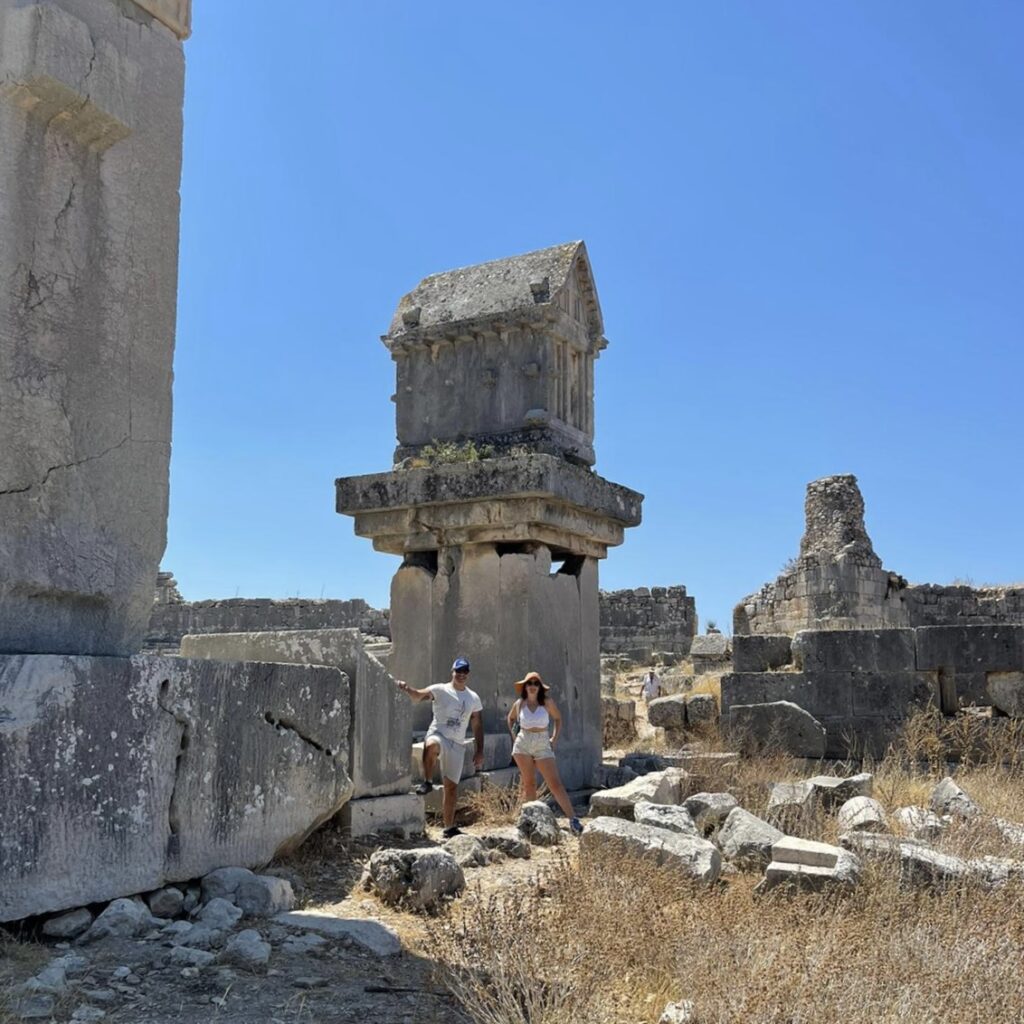
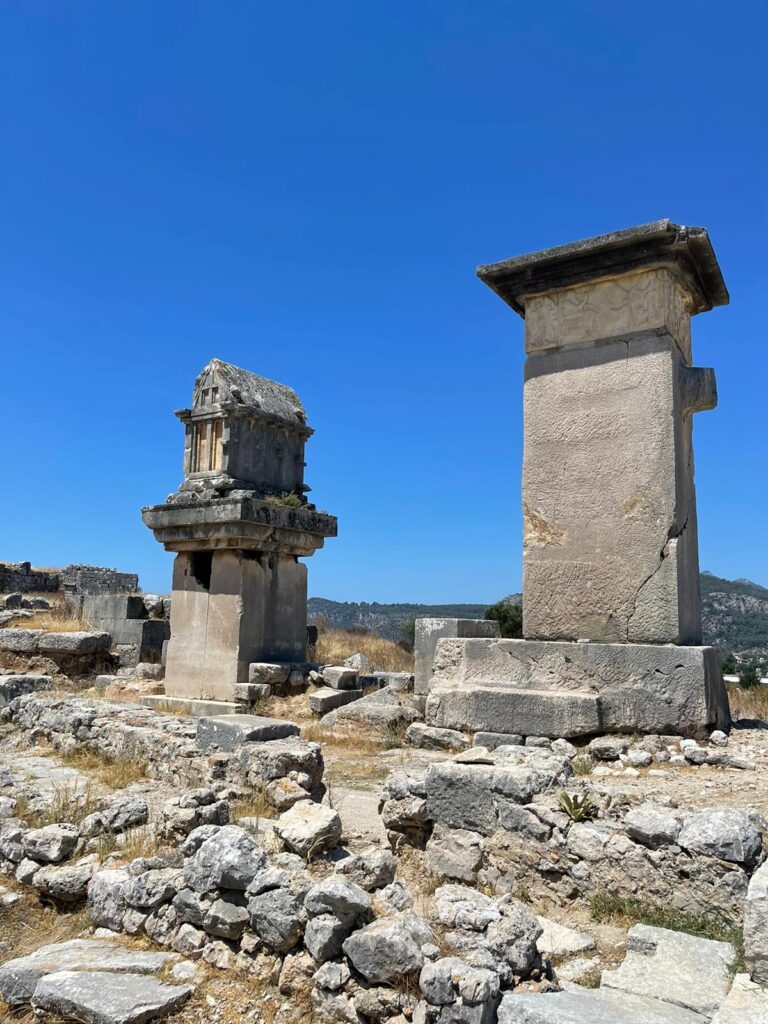
On both sides of the center of the ruins of Xanthos, there are pillared tomb monuments and a theater. The Obelisk of Xanthos, which is the monument closest to the entrance of the agora, rises above a burial chamber and is decorated with reliefs depicting battle scenes. The presence of an ancient Greek text alongside a long Lycian text indicates a period connected with the culture of the enemies of the Lykes in the 5th century BC. Although the pillared tomb monument with a sarcophagus is dated to the 4th century BC due to the Hellenistic style engraved motifs, the ceramic sherds found in the lower layers suggest that the tomb was built in the second half of the 6th century. It was also revealed that a sarcophagus was added in the 4th century and then re-used in the 3rd century.
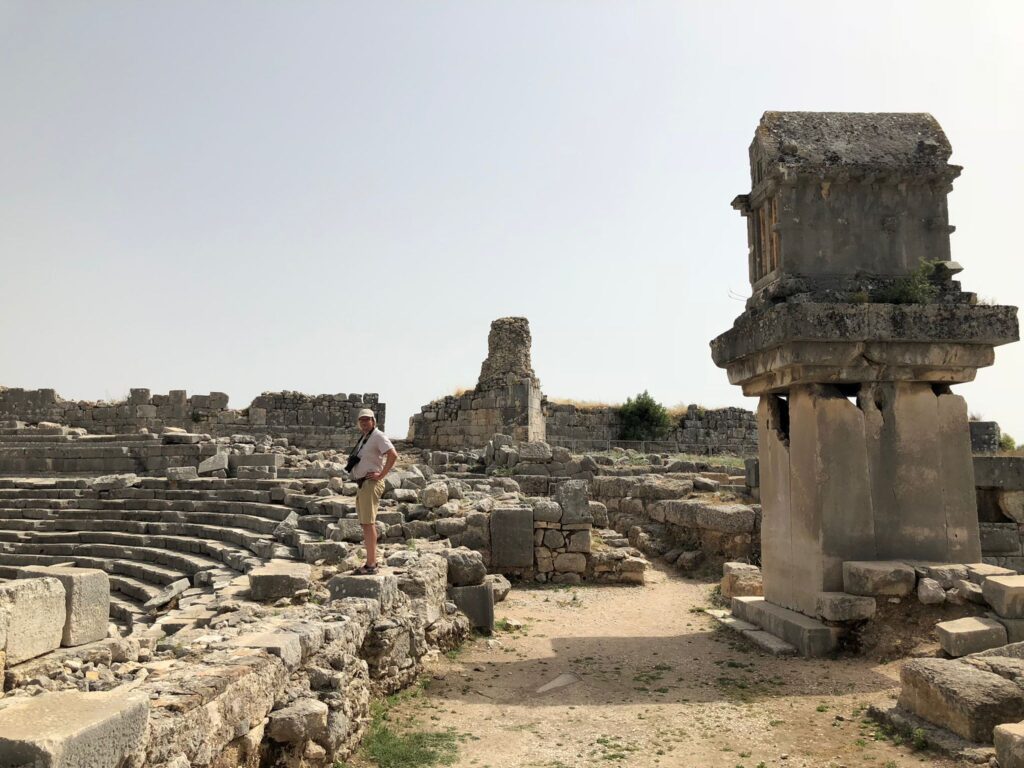
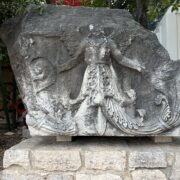
The other monument is the Harpy Monument of 480 BC, the tomb of a king whose name has never made its way to this day in any script. The relief sculptures, half female and half bird-shaped creatures, are associated with the “Harpys” of Greek mythology, who carried the souls of newborn children that died untimely. The monumental tombs and the tombs surrounding them, tell us that the Lyks continued to bury their dead inside their cities even during the period when they were heavily Hellenized.
As we continue on the paved road, we come across a sarcophagus in the northeast of the city with engraved dancer figures on its lid, dated to the middle of the 4th century BC. Just like the excellently crafted Lycian sarcophagi, it rests on a massive stone pillar on a stepped base with the main part of the sarcophagus, the basin, and the saddle-shaped lid.
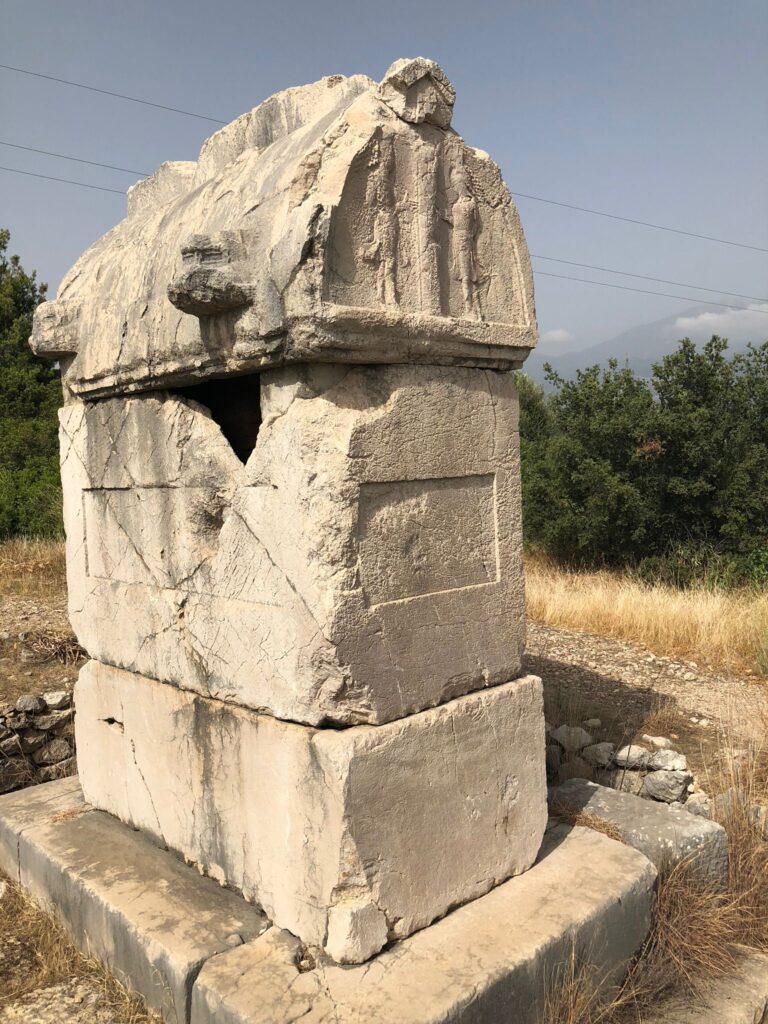
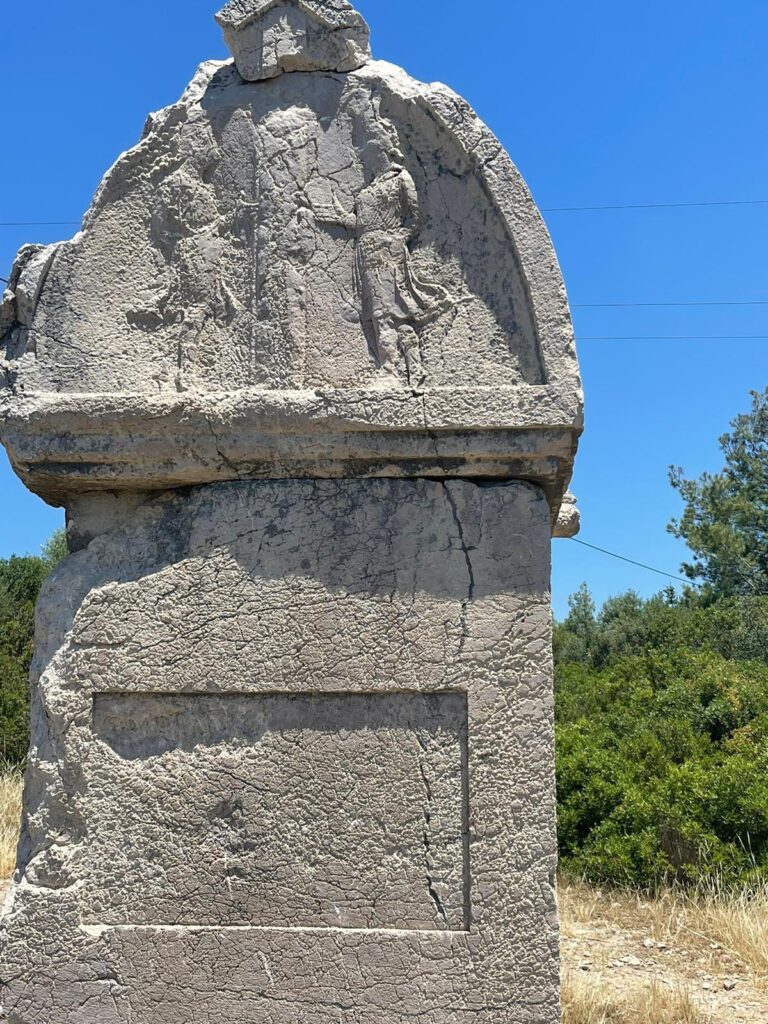
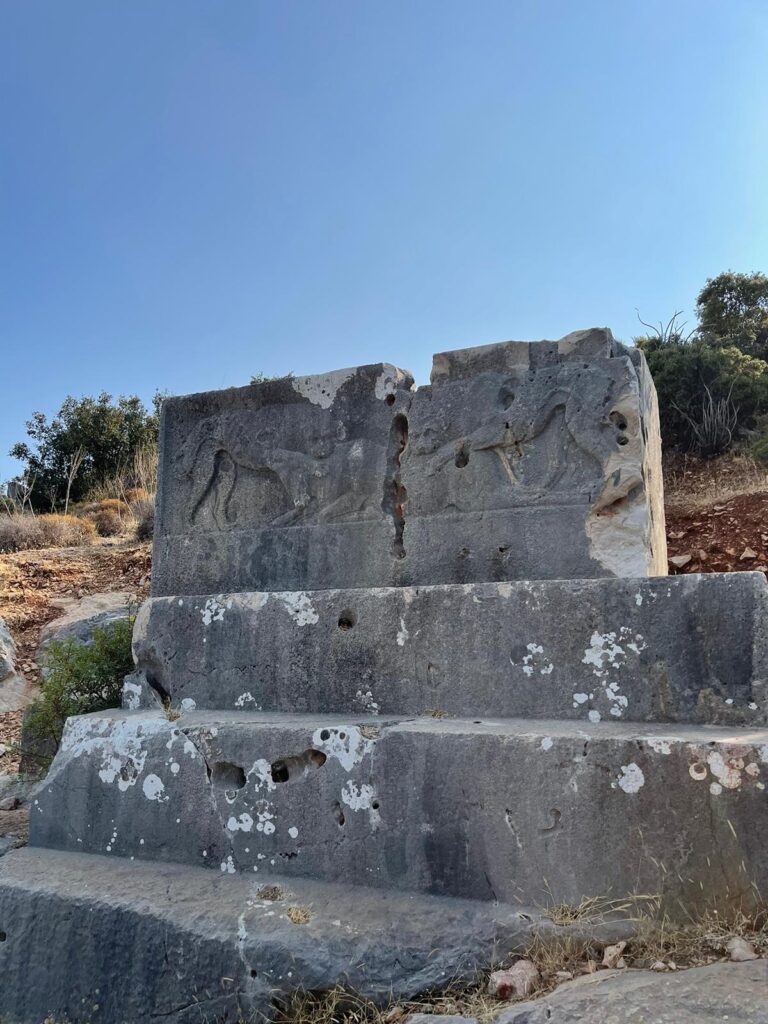
Further along the same road, the remains of ‘The Lion Tomb’ are to be seen. The lion symbolized death as the guardian of the grave among the peoples of Asia Minor and Greece, while Persian and Assyrian lions represented the power of the ruling power. During the second half of the 6th century BC when this tomb was built, Lycia was under the rule of the Achaemenid Persians. Therefore, the lion figure may have been chosen to demonstrate their allegiance to the Persian kingdom.
İlknur K. Tütken
References:
A. Balland, Les Dossiers de Archeologie, 1998, pp. 56-57
Jacques des Courtiles, Ksanthos-Letoo Guide, 2003
C. Le Roy Dossiers de l’archeologie, December 1998, pp. 42-50
Kaynakça: A. Balland, Les Dossiers de Archeologie, 1998, 56-57 Jacques des Courtils Ksanthos- Letoon Rehberi, 2003
C.Le Roy Dossiers de l‘archeologie, Aralık 1998, 42-50
Lykia, Cevdet Bayburtluoğlu, Suna-İnan Kıraç, Akdeniz Medeniyetleri Araştırma Enstitüsü, 2004, 261-264
Lykien, Frank Kolb, Geschichte einer antiken Landschaft, 2018